domingo, 25 de abril de 2010

Arts Blog


http://blog.makezine.com/burial-ceiling.jpg

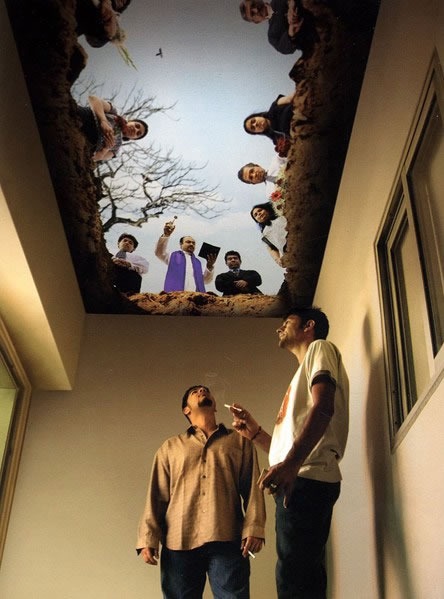
  1. Intention of the Artist: The artist wanted to portray that people who smoke are already six feet under, that they might as well be planning their funeral. He wanted to catch the audience's attention with his way of viewing smoking and how harmful it is.
  2. Quality of the Work: The picture is a clear work of art because it is a very interesting and true concept. It is highly educational and the way it is portrayed is very appealing to the eye because it is unlikely to be watching people as if they were inside a grave.
  3. Response of the Audience: I think that this an entertaining and interesting work of art. I find it very enjoyable and this definetely caught my attention as a non-smoking person but I think this would catch anybodies attention, non-smoker or smoker.

  1. Art as Imitation: This is an original piece of artwork and it is nothing like any other picture that I have seen before and it gives a real message that many other pictures transmit as well but this picture does it in a very original and entertaining way.
  2. Art as Communication: This picture has let me know that smoking is harmful and can kill you, and I like how it is transmitted and it is demonstrated clearly in a very entertaining and appealing way.
  3. Art as Education: This picture clearly shows that smoking is harmful and it teaches us that it can kill us and this is done with and entertaining image that catches the audiences's attention.

lunes, 19 de abril de 2010

The Stroop Effect

1.The Stroop Effect experiment was designed to create many different stimuli to test the reaction time of the participant taking the test and thus prove if the introduction of different stimuli affect an individual's reaction time.

2.John Ridley Stroop created three different type of stimuli by making three different versions of the same test. In the first one, names of colors appeared in black ink. In the second, names of colors appeared in a different ink than the color named. Finally in the third one, there were squares of a given color. Every participant had to read each one of the names with the different stimuli.

3. As a result, Stroop identified a large increase in the time taken by participants to complete the color reading in the second task compared to the naming of the color of the squares in experiment 2 while this delay did not appear in the first experiment. This taught us that humans can onyl concentrate on one object to fully be able to perform a task.


domingo, 11 de abril de 2010

Ethics Blog

Child Labor

http://www.globalenvision.org/files/Child_Labor07.10.08_0.jpg

The Bureau of Labor Statistics pegs the number of working children between the ages of 15-17 in the USA at 3.7 million.*

The outcry against soccer balls stitched by children in Pakistan led to the relocation of workshops ran by Nike and Reebok.*

Thailand, sub-Saharan Africa, Brazil, or Morocco and they will tell you how they regard this altruistic hyperactivity - with suspicion and resentment.*
*http://samvak.tripod.com/childlabor.html

I think that if a kid wants to work he should have the right to work but in workable conditions and for a fair salary but I do not think that a child should be forced to work because I wouldn't like to be forced to work and worse if it is in non-workable conditions.

jueves, 25 de marzo de 2010

Historical Analysis
Origin: United States. It is from the point of view of the members or followers of the Ku Klux Klan (KKK).
Purpose: To make people believe that what the KKK does is acceptable.
Value: This is important because people all around the world believe that what the KKK does is wrong and this reassures their belief.
Limitations: There is no label on the cartoon that says that the person in the picture is part of the KKK, we are just assuming that because it looks like them but we are not sure.

domingo, 21 de marzo de 2010

Natural Fractals


These pictures of lightning bolts are clear examples of fractals, each of the small lightning bolts look very similar to the original lightning bolt, they repeat over and over and get smaller everytime they but very similiar to the original, which is one of the basic characteristics of fractals.
http://thehiveiscoming.files.wordpress.com/2009/07/fractal-lightning.jpg


This video shows that even though lightning bolts are dangerous natural marvels it doesn't explain the mathematical significance of lightning strikes, and fractals do.

http://www.youtube.com/watch?v=2wY_t7zVIXY

domingo, 14 de marzo de 2010

Natural Science Blog
David Reimer

In 1965 David Reimer was born in Canada. When he was 8 months old, he was taken to the hospital to have a circumcision done. Unfortunately, his penis was burned off during this standard procedure due to the fact that the physician used an electrocautery needle instead of a standard scalpel. David's parents went to a psychologist named John Money and he suggested that a sex change was the simplest solution. David's parents agreed without knowing that Dr. Money had other intentions than to help them. He wanted to use David as his private case study to prove that nurture, not nature, determined gender identity. David had a vagina constructed and was given a hormonal treatment, he was now known as Brenda.


This experiment was completely unethical because John Money used David as his own private case study, and told David's parents to change David's sex so he could have a case to research on, he was not profesional at all. He did not tell them that he wanted to do this experiment so he did not have their consent or David's as we was not aware of this at all. He did not take into account all the different problems that this would bring into David's family's life and David's as well. David's mother was suicidal, his father was an alcoholic and his brother was severely depressed. David's parents decided to tell him what had happened when he was 14, and he decided that he wanted his penis to be reconstructed. After many year of struggling with gender identity he committed suicide at age 38.

domingo, 7 de marzo de 2010

Perception Post
"Doubt is the key to knowledge" (Persian Proverb)
Perception is how we see things and doubt is a key element in perception. When we see something we don't necessary need to believe it, it depends on how we perceive it that make us believe something immediately or have doubts about it. When we doubt something we have this tendecy to try and get the correct answer and therefore we acquire more knowledge.
1. A cultural example could be that not all cultures believe in God. Some cultures perceive God as a superior being but they don't call it God. Some cultures have doubts about God's existence and they all have different ways and paths to search for this "truth".
2.In school sometimes teachers make mistakes and most of the time they are not corrected and we end up learning something that is not correct. But sometimes some one notices the teacher's mistake and doubts that what he/she said is correct, so he asks and then the correct answer is given and knowledge is acquired thanks to the student's doubt.
3. One time, I was in my math class with Mr. McDowell and he was solving an equation on the board but for some reason I doubted that the answer was correct, something didn't look right. So then I started solving the equation on my own, and I figured what he did wrong and I corrected him. Thanks to my doubt everybody was corrected and acquired the real knowledge, thanks to the way I perceived the problem.